LEADING WITH HORSES
LEADING WITH HORSES
LEADING WITH HORSES


Benefits of EAP
ABOUT OUR SERVICES


We are proud to make the benefits of equine-assisted activities accessible to vulnerable and underserved demographics through an inclusive, sensory-rich environment.
Therapy and clinical services at Second Chance Ranch are provided by independent licensed mental health professionals who partner with us to integrate equine experiences into their therapeutic or educational work.
Their work centers on suicide intervention, prevention, and awareness, while also supporting individuals navigating PTSD, trauma, and learning differences—using the profound connection with horses to help individuals rebuild trust, strengthen resilience, and restore hope.
Through guided interaction with the herd, participants develop resilience and explore new ways to navigate the effects of trauma and toxic stress in a supportive, nonjudgmental setting. Creative elements such as music and painting are often integrated alongside the natural rhythm and movement of the horses, offering additional pathways for emotional expression, regulation, and connection. Together with our partners, we help create meaningful experiences that inspire the mind, strengthen the body, and lift the spirit.
Our programs address the root causes of suicide risk—trauma, isolation, emotional dysregulation, and loss of purpose. We serve youth, families, and veterans in an inclusive, sensory-rich environment where individuals experience safety, connection, and hope. Many participants come to us after traditional therapies have stalled; through the intuitive, nonjudgmental presence of horses, and through experiential elements such as music, guided rhythm work, and art-based reflection - they discover new ways to regulate emotions, communicate, and reconnect with life.
SCR is the only EAP platform in the Pacific Northwest offering services with no additional charges to those enrolled through a therapist or mental health agency - we are funded through grants, donations, and collaborative partnerships with licensed mental-health professionals. Our work addresses a broad spectrum of challenges linked to suicide risk that are related to suicidal ideation, including PTSD, depression, anxiety, substance misuse, trauma recovery, and social reintegration. Agencies and clinicians consistently report measurable improvements in communication, emotional regulation, distress tolerance, and engagement as clients engage both somatic and creative pathways for healing.
The approach integrates evidence-based principles aligned with Dialectical Behavior Therapy (DBT), allowing clients to practice mindfulness, emotional regulation, and healthy boundaries in real time. Under the leadership of Executive Director and equine-behavior specialist Katie Merwick, our programs combine clinical expertise with the healing power of horses and expressive modalities that support nervous-system regulation and authentic self-expression to rebuild stability, trust, and resilience.
THE CORE PROGRAMS
Second Chance Ranch partners with mental health professionals, schools, and community-based military agencies that integrate equine experiences into their therapeutic and educational programs. As therapy is provided by these partner professionals, we do not schedule appointments directly with visitors. Individuals interested in participating are encouraged to connect with one of our partner providers to arrange services.
To support these professionals, Second Chance Ranch offers three primary pathways: partnerships with licensed therapists incorporating Equine-Assisted Psychotherapy, programs designed for schools and youth groups, and our Horses for Heroes gatherings — a non-clinical support community for veterans and their families.
1. Clinical Partnerships for Equine-Assisted Psychotherapy & Learning (EAP/L)
A clinical, evidence-based modality facilitated by licensed mental-health professionals and equine specialists. EAP/L helps clients facing trauma, PTSD, depression, anxiety, grief, and other challenges directly tied to suicide risk. Horses mirror emotions and respond authentically, enabling clients to build mindfulness, emotional regulation, communication skills, and self-awareness. Sessions may incorporate rhythm-based exercises, music, or reflective art practices to deepen emotional processing and reinforce therapeutic goals. Sessions are individualized to each client’s treatment plan and require no prior horse experience.
2. Pursuit of Harmony for Youth & School
A non-clinical equine-assisted learning program for youth navigating cognitive, behavioral, and emotional challenges. Offered in partnership with schools and youth organizations, students attend with school program staff, while the Second Chance Ranch team provides a guided experience as equine specialists. Pursuit of Harmony offers a safe, structured environment for self-discovery, confidence building, problem-solving, and emotional resilience. Activities may incorporate horses, art, and music to support creativity, emotional regulation, and healthy expression.
3. Horses for Heroes – Military & Veteran Gatherings
Horses for Heroes is a relaxed, community gathering for service members, veterans, and their families. This is not a therapy program—just good company, good horses, and the kind of connection that happens when people who share a military background spend time together.
Participants enjoy guided interaction with the herd, casual conversation, and optional music or creative activities. Horses have long been trusted partners to the military, and these gatherings simply continue that tradition—offering a place to decompress, share stories, and enjoy the steady rhythm of hoofbeats, heartbeats, and camaraderie. And, the occasionally the reminder that someone else at the ranch also appreciates snacks.
How It Works
By integrating the horse-to-human connection, we offer experiential learning where the meaning and the process is solely based on the individual’s personal experience, rather than being “taught” through someone else’s experience. Often professionals find their clients to be more receptive of accepting information from the horses through this non-verbal, alternative to talk therapy. And, as well, more open to expressing themselves, than if directly speaking about their issues. By allowing them to process information in a different way, it allows professionals to observe their client’s triggers and respond to them in real-time counseling. The professional and client can work freely in a safe environment to elicit, decipher, prove and encourage their clients healing and growth. This team approach of licensed mental health professional and equine expert offers a safe, controlled environment for the client. Sessions are structured and facilitated to specifically address the reasons clients come to therapy, and designed to best create metaphors to “real life”. Clients have shown us that the they truly do have the answers they seek, when given the opportunity to discover them.


Why Horses?
The unique nature of the horse is what makes the therapy so successful. Horses reflect the behavior and emotional state of the people around them and provide us with immediate and effective feedback. The most important element of therapy is trust. There is an unspoken truth that horses don’t lie or deceive. Not because they are altruistic, but because they are incapable of deceit as an animal who cannot concoct an alternate tale of reality. As the horse builds trust, they connect deeper with the person. This quite often provides the client with a feeling of comfort and the opportunity to break down barriers and address the challenges they have been facing. Horses have a majestic and powerful presence. For people who lack confidence, being put in a position of leadership over a 1000lb animal and successfully managing that animal can build self-esteem and self-confidence. Or even those who have false overconfidence, the horse teaches humility through example as these powerful creatures live peacefully and cooperatively with us.
The three basic aspects of learning from equine therapy
Metaphoric Learning
Horses share much of the same personality traits and emotions as humans; they are dynamic, playful, curious, emotionally sensitive – but more consistently, honest, and unbiased. Activities with the horses challenge participants to work together to find solutions through positive communication and collaboration. It is an experience that becomes a metaphor for real-life situations. The unpredictability of these activities and their outcomes require participants to apply and develop important relationship and life skills. The most important aspect of these activities is not whether the goal is achieved but rather identifying patterns of behavior and emotional response that relates to the modern-day experience.
Experiential Learning
The strength of experiential learning is that the meaning and the process is solely based on the individual’s personal experience, rather than being “taught” through someone else’s experience. As prey animals, horses have evolved exquisitely sensitive perceptual abilities that far exceed that of humans. As herd animals, they have developed a refined ability to read body language and emotional incongruence. Horses are masters of presence. The horses are powerful teachers of the integrity of will, intent, energy, and alignment. Quite simply, horses change the way we see ourselves.
Non-Verbal Communication
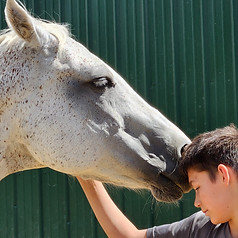
People typically learn best by doing. Life lessons take deeper root when individuals understand them in their minds and experience them in their bodies. Horses respond with unique insight into exactly who we are in the moment. They are profoundly gifted reflectors of our true selves because their very survival depends on reading us correctly. Subtle changes in our actions or behaviors can provoke responses that give us immediate feedback about ourselves – they are an excellent source of organic biofeedback able to mirror our emotions and provide non-judgmental feedback. Through interaction with the horse, even running a hand over a neck, or putting fingers out to touch a muzzle, can do much to open a door to ideas or thoughts not before disclosed. In a world of technology, voice, the spoken kind has seemed to have lost its importance. What horses offer to the community is an exploration of the self and self-discovery. A model of the show and not tell.
Leading with Horses has created a safe place for coaches, therapists, researchers, and individuals to explore their behaviors. We believe horses are uniquely adapted to coach humans. SCR offers a curriculum and structure that provides opportunities to teach critical life and communication skills.

-
Honest, non-judgmental feedback gains immediate trust – clients are willing to be more emotionally vulnerable.
-
Stimulus/Response: immediate responses by the horse demonstrates patterns of behavior and belief systems by both equine and handler
-
Non-verbal interaction tests ideas of connection and attachment. Horses communicate mostly with body language and limited vocal communication. Thus, clients are able to observe and practice how non-verbal communication might be impacting or influencing others in their lives.
-
Awareness and Focus. Handling a large and powerful animal or dealing with the unknown creates a need for boundaries, awareness, and horsemanship/handling requires that we are observant, focused, and attentive.
-
Confidence: Horses are a majestic and powerful presence. For those who lack confidence, successfully managing and training a horse can build self-esteem and self-confidence. Or even those who have false overconfidence, the horse teaches humility through example as these powerful creatures live peacefully and cooperatively with us.